
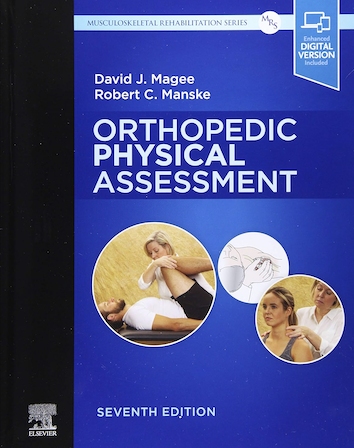
Textbook Review: Orthopedic Physical Assessment, 7th Edition – by Magee and Manske
Reviewed by: James Demetrious, DC, DABCO
Verdict in Brief:
This text is a comprehensive and well-organized refresher on orthopedic assessment, remaining a staple for students, early-career clinicians. It excels at cataloging tests, regional exam flow, and pragmatic red-flag screening.
That said, this reviewer respectfully diverges on three fronts: (1) overreliance on named orthopedic tests with variable diagnostic utility, (2) limited integration of contemporary risk stratification and prognosis frameworks, and (3) underemphasis of decision rules, imaging appropriateness, and vascular/neurovascular differentials in the cervical-cranial region.
Addressing these would elevate an already valuable text into a truly modern guide for advanced practice.
What it Does Well (Pearls you can use Monday Morning):
-
Regional roadmaps: Each chapter offers a clear sequence—history → observation → motion → palpation → special tests—useful for teaching and for structuring documentation.
-
Test descriptions & visuals: Step-by-step photos and consistent descriptions make it easy to teach or refresh techniques before clinic or lab sessions.
-
Red flags & differentials: The inclusion of red-flag checklists and common masqueraders (e.g., viscero-somatic referral) keeps examinations anchored in safety.
-
Functional emphasis: Coverage of movement analysis and kinetic chain considerations reminds readers to look beyond a single painful structure.
-
Tables worth bookmarking: Condensed summaries (capsule patterns, innervation maps, capsuloligamentous stress tests) are handy for rapid reference.
Respectful Disagreements (and why they matter):
-
Test-centric bias: The book remains somewhat test-forward in regions where single special tests show modest likelihood ratios and wide inter-rater variability. In 2025, best practice leans toward clusters (history features + exam findings + select tests) and probabilistic reasoning rather than binary “positive/negative” interpretations.
-
Heterogeneous evidence appraisal: While the text cites literature, the hierarchy of evidence and precise diagnostic metrics (LRs, post-test probabilities) aren’t always foregrounded. Without this, learners can overvalue legacy tests.
-
Neurovascular nuance in the neck: The cervical section could more explicitly integrate vascular risk screening, neurovascular symptom recognition, and imaging decision pathways (e.g., when to escalate to CTA/MRA versus conservative care), given the low incidence yet high consequence of missed pathology.
NOTE: This reviewer disagrees with the inclusion of vertebral artery dissection/compromise testing, as there is no literature, that supports the predictive capability of these orthopedic tests.
-
Imaging appropriateness & decision rules: Ottawa, Pittsburgh, Canadian C-Spine, and ACR Appropriateness Criteria® are valuable clinical guardrails; their integration feels more peripheral than central.
-
Prognosis & trajectory: Modern MSK care emphasizes early prognosis indicators, stratified care, and return-to-function timelines. These threads appear but could be woven more tightly with exam findings to inform shared decision-making.
Recommendations to enhance utility (quick wins for faculty and clinicians):
-
Lead with probabilities: Precede special tests with a one-page diagnostic pathway per region: key history items (with LRs), movement findings, and then the 2–3 best-supported tests as a cluster.
-
Embed calculators: Add worked examples of pre-test → post-test probability using likelihood ratios (with a Fagan nomogram graphic).
-
Vascular & serious pathology box: A dedicated “Cervical Neurovascular Triage” spread: risk factors, red-flag constellations, immediate actions, and imaging triggers.
-
Decision rules up front: Place Ottawa/Canadian C-Spine rules and ACR tables as laminated-style inserts or margin callouts for rapid access.
-
Prognosis tables: Summaries linking early exam predictors to expected recovery curves and when to pivot care plans or refer.
-
Teach test clusters, not catalogs: For each condition, highlight top clusters with pooled stats, and relegate low-value tests to an appendix.
-
Inter-rater reliability icons: Simple icons (↑, ↔, ↓) beside each maneuver to cue reliability at a glance.
Bottom Line:
Magee & Manske’s 7th edition remains a strong, practical review of orthopedic assessment and is particularly useful for teaching structure and technique. To fully serve advanced, risk-aware practice, a shift from test catalogs to evidence-based diagnostic pathways, with explicit probabilities, decision rules, and neurovascular triage, would make this classic not just comprehensive, but decisively contemporary.
Reference:
- Magee DJ, Manske RC. Orthopedic Physical Assessment, 7th edition; 2021, Elsevier Inc.

PostGradDC offers advanced post-graduate chiropractic continuing education. Our founder, Dr. James Demetrious, is a distinguished board-certified chiropractic orthopedist, educator, author, and editor.
© 2025 – James Demetrious, DC, DABCO. Open Access. Unrestricted use, distribution, and reproduction are allowed in any medium, provided you give appropriate credit by citing the original author and source: Demetrious J. Textbook Review: Orthopedic Physical Assessment, 7th Edition – by Magee and Manske. PostGradDC.com; 2025.
