
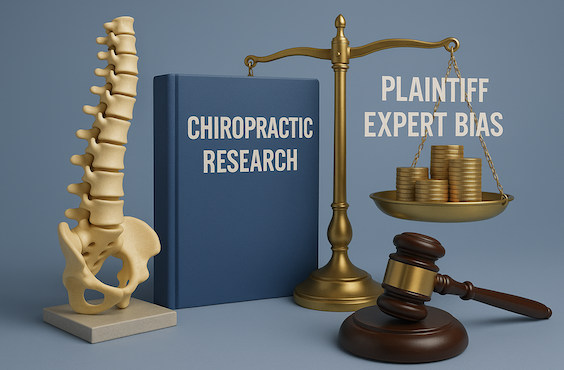
Chiropractic Care and Stroke: Exposing Bias and Protecting the Integrity of Science
Written by: James Demetrious, DC, DABCO
Board-Certified Chiropractic Orthopedist
Founder, PostGradDC
Introduction
A growing number of medico-legal cases have been influenced by plaintiff expert witnesses who promote speculative and scientifically unsubstantiated claims linking chiropractic care to stroke. These witnesses, often financially motivated, rely on low-level evidence, confirmation bias, and deliberate misinterpretation of high-quality epidemiological data to fabricate a false appearance of causation.
Such behavior represents a grave ethical breach that corrupts the scientific process, misleads the courts, and damages public trust in legitimate healthcare professions. This article challenges that misconduct and reaffirms the overwhelming body of scientific evidence demonstrating that chiropractic care does not cause cervical artery dissections or thromboembolic stroke.
The Weight of the Evidence
The best available research, including population-based studies by Cassidy, Whedon, Kosloff, and Church, has examined hundreds of millions of patient interactions over several decades. These investigations consistently reveal no causal relationship between chiropractic manipulation and vertebrobasilar or carotid artery stroke.
Patients who experience dissection-related symptoms are equally likely to have sought care from a chiropractor or a medical physician. These findings, replicated across multiple studies and jurisdictions, form an evidence-based consensus that cannot be ethically denied.
The Problem of Financially Driven Expert Testimony
Despite the clarity of this evidence, some self-styled “experts” continue to testify in court that chiropractic manipulation directly causes vascular injury and unproven thromboembolic mechanisms of stroke. Their claims are unsupported by credible data and are instead driven by financial incentive and professional opportunism.
These individuals often function not as neutral scientific experts but as paid advocates, crafting testimony to fit a narrative designed to influence juries and secure favorable verdicts. Their professional livelihood depends not on research or clinical integrity, but on sustaining a false controversy that serves the litigation industry.
Such conduct is not merely misguided; it is ethically reprehensible. When individuals distort science for monetary gain, they betray both the patient and the profession. They also exploit the legal system’s vulnerability to scientific illiteracy, substituting speculation for evidence under the guise of expertise.
Tactics of Misrepresentation
Financially motivated witnesses typically employ several predictable tactics:
- Selective citation: Extracting isolated sentences from reputable studies while omitting the authors’ conclusions that refute causation.
- Amplification of case reports: Presenting anecdotal, uncontrolled observations as if they were representative or causative.
- Misapplication of biomechanics: Theorizing mechanical mechanisms of thromboembolism that are physiologically implausible and unvalidated in vivo.
- Dismissal of epidemiology: Denigrating high-level studies as “inconclusive” while treating speculative hypotheses as definitive.
- Speculation: By misquoting authoritative and non-authoritative sources.
These tactics mirror the hallmarks of confirmation bias, seeking only evidence that supports a predetermined conclusion while ignoring the vast body of contradictory data. In any other field of health science, such methods would be considered academically and ethically unacceptable.
The Hierarchy of Evidence: A Forgotten Standard
Modern evidence-based medicine depends upon a clear hierarchy of scientific validity. Level I and II evidence, including meta-analyses, systematic reviews, and population-based studies, carries the highest weight. Case reports, anecdotes, and editorial opinions occupy the lowest rungs of reliability.
Plaintiff experts who rely on Level IV or V evidence while dismissing the hierarchy do so knowingly. They mislead courts by equating anecdotal coincidence with causation. Such distortion is not ignorance; it is intentional deception for professional and financial gain.
This behavior disrespects the scientific process, misinforms juries, and undermines legitimate experts who testify with balance, transparency, and integrity.
Ethical and Professional Consequences
Expert testimony in healthcare-related litigation carries a profound ethical obligation. Witnesses are expected to present a full, balanced, and truthful interpretation of the scientific record. When they instead manufacture controversy or promote fear to serve plaintiff interests, they become complicit in fraud by omission.
This conduct harms four groups simultaneously:
- Patients, by spreading misinformation that discourages access to safe, conservative care;
- Courts, by corrupting the evidentiary process with biased pseudoscience;
- Healthcare professionals, by defaming ethical practitioners through innuendo and conjecture; and
- The chiropractic profession, by misinforming and frightening students and doctors from performing chiropractic care that has been proven to reduce opiate and surgical adverse effects.
It is the duty of honest experts, chiropractic and medical alike, to expose this behavior and insist on scientific accountability in the courtroom.
The Broader Impact on Public Trust
When expert witnesses misrepresent chiropractic safety, they do not merely attack a profession; they undermine public confidence in science itself. Every instance of courtroom deception magnifies public misunderstanding, fuels sensationalized media coverage, and discourages patients from seeking non-invasive, evidence-based care.
Meanwhile, the chiropractic profession continues to evolve, guided by data, diagnostic precision, and the principles of ethical care. By maintaining our standards and addressing misinformation, we not only preserve our credibility but also ensure the safety and trust of the patients we serve.
A Call to Restore Integrity
The time has come for professional boards, licensing authorities, journal editors, and expert panels to hold courtroom witnesses accountable for scientific malpractice, including the deliberate misrepresentation of evidence for financial gain.
Chiropractic physicians must continue to educate attorneys, juries, and the public with integrity and composure. Our message is grounded in data, not emotion:
- The incidence of stroke following chiropractic care is exceedingly rare and statistically indistinguishable from that following medical care.
- High-level studies have disproven causation.
- Claims to the contrary are the product of bias, profit motive, and poor scholarship.
- Science is not for sale. Truth is not negotiable.
Conclusion
The suggestion that chiropractic care causes stroke is a disproven hypothesis, perpetuated by a small circle of financially motivated plaintiff experts who rely on distortion rather than data. Their tactics represent the antithesis of scientific integrity and threaten both the legal system’s credibility and the public’s trust in the healthcare system.
The chiropractic profession stands firm in its commitment to honesty, evidence, and ethical responsibility. We do not fear scrutiny because the facts are on our side. It is time for courts, clinicians, and the public to recognize that those who exploit fear for profit do not represent science; they represent themselves.
Author’s Note
The chiropractic profession’s foundation rests on integrity, evidence, and a relentless commitment to truth. Those who distort science for financial gain undermine the foundation of science and betray the trust patients place in healthcare. We must continue to lead with honesty, educate with humility, and defend our profession with facts, not for profit, but for principle. Integrity is not an opinion; it is a standard.
References
References associated with this article are available in our PostGradDC coursework.
Disclosure
The information provided in this article and all PostGradDC coursework should not be considered standards of care. We provide this information for educational purposes only. This information is not intended to be a substitute for professional medical advice, diagnosis, or treatment. Always consult your physician or a qualified healthcare provider with any questions you may have regarding medical conditions or treatment. Seek the opinion of your legal representative. Errors and omissions are unintended.
Conflict of Interest Statement
Dr. James Demetrious is a board-certified chiropractic orthopedist, founder and CEO of PostGradDC, a privately operated provider of chiropractic continuing education. Dr. Demetrious is an independent member of the NCMIC Speakers’ Bureau. Dr. Demetrious teaches coursework on behalf of chiropractic colleges, state, and national organizations throughout the United States. Dr. Demetrious has published peer-reviewed research on these topics and provides consultation services to chiropractic physicians, attorneys, and professional organizations.
This commentary was written independently and without external funding. While his educational and advocacy activities promote evidence-based chiropractic practice, the views expressed herein are his own and are based on an interpretation of the current scientific literature. Any omissions are unintended, and concerns about COI can be amended.

PostGradDC offers advanced post-graduate chiropractic continuing education. Our founder, Dr. James Demetrious, is a distinguished board-certified chiropractic orthopedist, educator, author, and editor.
© 2025 – James Demetrious, DC, DABCO. Open Access. Unrestricted use, distribution, and reproduction are allowed in any medium, provided you give appropriate credit by citing the original author and source: Demetrious J. Chiropractic Care and Stroke: Exposing Bias and Protecting the Integrity of Science. PostGradDC.com; 2025.
