
Informed Consent: Ethical Imperative, Scientific Responsibility, and Legal Reality
Written by: James Demetrious, DC, DABCO
Board-Certified Chiropractic Orthopedist
Founder and CEO, PostGradDC
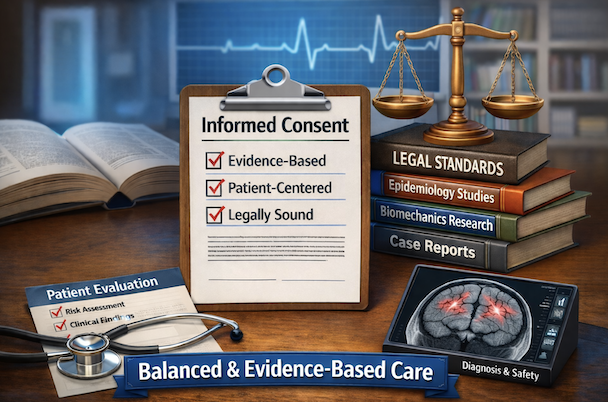
Informed consent is a foundational, ethical and legal obligation in modern healthcare. I strongly support its appropriate and meaningful application in clinical practice based on high-quality scientific evidence, accepted standards of care, and the legal requirements that govern healthcare delivery within respective jurisdictions.
Proper informed consent reflects respect for patient autonomy, professional transparency, and risk communication grounded in credible evidence. It requires clinicians to disclose material information that patients would consider relevant to clinical decision-making.
Importantly, the scope and content of informed consent are not determined by low-level evidence, speculation, anecdote, or litigation narratives. Rather, they are defined by the convergence of high-quality scientific evidence, professional standards, and the legal doctrines established within specific states and jurisdictions.
I do not support the concept of “universal informed consent” mandates that are not supported by high-quality research, established standards of care, or jurisdictional legal precedent.
While clinicians must always communicate potential risks honestly and responsibly, imposing universal disclosure requirements that lack sound scientific methodology or clear legal foundation risks misrepresenting the available evidence and undermining the true purpose of informed consent.
Ethical disclosure must be evidence-informed, clinically contextualized, and legally appropriate.
At PostGradDC, we emphasize the importance of informed consent as part of responsible clinical practice and professional risk management. To support practitioners in this critical area, we offer two dedicated courses available throughout the United States and internationally, focused specifically on informed consent, clinical communication, and medico-legal standards in chiropractic practice.
- Documentation and Informed Consent – 2 CE Hours
- Clinical Risk Management: Informed Consent – 1 CE Hour
These programs examine the scientific literature, legal precedents, and practical documentation strategies necessary for clinicians to meet both ethical and legal obligations while maintaining fidelity to the evidence.
I support, advocate and recognize the importance of appropriate informed consent processes. Informed consent should never be minimized. It must be grounded in sound science, recognized standards of care, and jurisdictional law, rather than unsupported assertions or extrapolations. When properly understood and applied, informed consent strengthens patient trust, improves clinical decision-making, and protects both patients and practitioners.
— James Demetrious, DC, DABCO
Board-Certified Chiropractic Orthopedist
Founder & CEO, PostGradDC
Legal Disclaimer
This publication is intended for educational and scholarly discourse regarding evidentiary standards, professional ethics, and the appropriate interpretation of scientific literature in clinical and legal contexts. It does not constitute legal advice, medical advice, or expert witness consultation. The content herein is not directed toward any specific pending litigation, individual, or jurisdiction.
Readers are advised to consult qualified legal counsel for guidance regarding specific legal matters. Clinical decisions must be based on independent professional judgment, current scientific evidence, patient specific presentation, and applicable regulatory requirements.
The opinions expressed are solely those of the author and are presented for academic and professional discourse.
Author Disclosures
James Demetrious, DC, DABCO is a board certified chiropractic orthopedist and the founder of PostGradDC, a for profit postgraduate continuing education organization that provides educational programming to licensed chiropractors. He receives compensation for course development, teaching, and professional speaking engagements through PostGradDC.
Dr. Demetrious has participated in medicolegal consultation and expert review involving chiropractic standards of care. He does not receive compensation contingent upon the outcome of any specific legal matter discussed or implied within this publication.
No external funding was received for the preparation of this manuscript.
Conflict of Interest Declaration
Dr. Demetrious declares that he is an independent member of the NCMIC Speakers Bureau. His participation in the NCMIC Speakers Bureau is educational in nature. He is not an employee, officer, policy maker, or spokesperson for NCMIC. The views expressed in this article are solely those of the author and do not represent the official positions of NCMIC or any affiliated organization.
The author affirms that the opinions presented are grounded in professional training, board certification, clinical experience, peer reviewed literature, and applicable legal precedent. He declares no financial interest contingent upon the outcome of any litigation referenced or discussed in general terms within this publication.

PostGradDC offers advanced post-graduate chiropractic continuing education. Our founder, Dr. James Demetrious, is a distinguished board-certified chiropractic orthopedist, educator, author, and editor.
© 2026 – James Demetrious, DC, DABCO. Open Access. Unrestricted use, distribution, and reproduction are allowed in any medium, provided you give appropriate credit by citing the original author and source: Demetrious J. Informed Consent: Ethical Imperative, Scientific Responsibility, and Legal Reality. PostGradDC.com; 2026.
