
Defending Chiropractic and Protecting Patients
Written by: James Demetrious, DC, DABCO
Board-Certified Chiropractic Orthopedist
Founder and CEO, PostGradDC
Red Flags
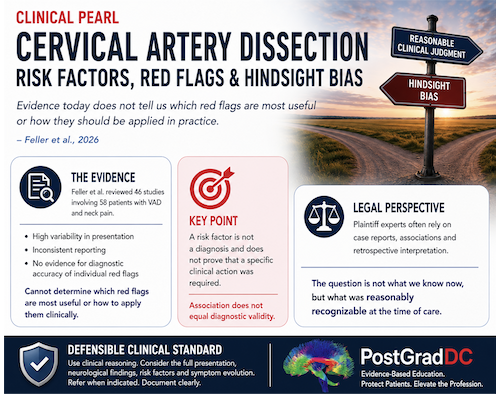
Cervical artery dissection (CeAD) presents a recognized diagnostic challenge. Its early manifestations may resemble common neuromusculoskeletal complaints. This uncertainty has important implications for patient safety. Feller et al. recently examined red flags associated with extracranial vertebral artery dissection (VAD) in patients presenting primarily with neck pain. Their scoping review included 46 studies involving only 58 patients. Most were case reports and case series. The authors found substantial variability in their review. Risk factors and examination findings were inconsistently reported. There was also insufficient diagnostic-accuracy evidence to establish the clinical utility of individual red flags.
Risk Factors Are Not Diagnostic Criteria
Feller et al. found that risk factors were frequently unreported. The available literature also failed to establish their diagnostic accuracy. Critically, the authors identified no observational studies reporting sensitivity or specificity for individual signs and symptoms. They concluded that it is currently impossible to determine which red flags are most useful for identifying extracranial VAD or how they should be applied in practice. This distinction is fundamental. An association is not a diagnostic test. The presence of a risk factor does not establish that VAD was clinically recognizable at a particular encounter.
Plaintiff Expert Testimony: Methodology Matters
This issue becomes particularly important in malpractice litigation. After vascular imaging establishes a dissection, a plaintiff expert may retrospectively identify a symptom, historical feature, or risk factor. The expert may then characterize it as a warning that should have compelled the chiropractor to suspect VAD, refer the patient, obtain vascular imaging, or withhold treatment.
Such opinions deserve rigorous methodological scrutiny. A recurring weakness in some expert testimony is the transformation of association into diagnostic certainty. A factor reported in case studies or associated with CeAD does not automatically have diagnostic value. Such evidence does not establish sensitivity, specificity, likelihood ratios, or predictive value.
It also does not establish an ability to distinguish VAD from far more common causes of head or neck pain. Yet these associations may be selectively cited after the outcome is known. The result can be an appearance of diagnostic certainty that the underlying research does not support.
Feller et al. expose the weakness of this methodology. They found substantial heterogeneity among proposed red flags. They also noted that many recommendations rely largely on spurious expert opinion rather than established diagnostic-accuracy evidence. Expert opinion should not be presented as established science.
When an expert relies on low level evidence and associations, poor methodology, self-citation, or unsubstantiated conclusions, those limitations should be acknowledged. An opinion does not become scientifically reliable simply because it is expressed confidently or repeatedly.
The appropriate questions are straightforward:
- What evidence demonstrates that this finding reliably identifies VAD?
- What evidence establishes that its presence required a reasonably prudent chiropractor to act differently.
Without that foundation, retrospective certainty risks becoming advocacy rather than reliable diagnostic methodology.
The Defensible Clinical Standard
Feller et al. recommend clinical reasoning rather than reliance on an isolated red-flag checklist. Relevant considerations include pain characteristics, risk factors, preceding neurological symptoms, history, examination findings, and symptom evolution. Referral is appropriate when the overall presentation raises sufficient concern. The standard is neither diagnostic perfection nor retrospective recognition of every conceivable risk factor. It is reasonable clinical judgment based on the patient’s presentation and the information available when care was rendered.
Limitations
Observations derived primarily from case reports should not be transformed into validated diagnostic criteria or mandatory standards of care. The authors themselves emphasize that the available evidence cannot establish the diagnostic utility of individual red flags.
PostGradDC
At PostGradDC, our continuing education emphasizes CeAD differential diagnosis, neurological assessment, recognition of serious pathology, appropriate referral, documentation, and evidence-informed clinical reasoning. Our objective is to protect patients and improve clinical decision-making. We also seek to help chiropractors practice in a manner that is scientifically and professionally defensible.
Chiropractic care should be evaluated according to credible evidence and reasonable standards of practice, not reconstructed through hindsight or unsupported expert certainty.
Reference: Feller D, Mourad F, Maselli F, et al. Red flags for extracranial vertebral artery dissections in patients with neck pain: a scoping review. Journal of Manual & Manipulative Therapy. Published online August 20, 2026.
Legal Disclaimer
This publication is intended for educational and scholarly discourse regarding evidentiary standards, professional ethics, and the appropriate interpretation of scientific literature in clinical and legal contexts. It does not constitute legal advice, medical advice, or expert witness consultation. The content herein is not directed toward any specific pending litigation, individual, or jurisdiction. Readers are advised to consult qualified legal counsel for guidance regarding specific legal matters. Clinical decisions must be based on independent professional judgment, current scientific evidence, patient specific presentation, and applicable regulatory requirements. The opinions expressed are solely those of the author and are presented for academic and professional discourse.
Author Disclosures
James Demetrious, DC, DABCO is a board certified chiropractic orthopedist and the founder of PostGradDC, a for profit postgraduate continuing education organization that provides educational programming to licensed chiropractors. He receives compensation for course development, teaching, and professional speaking engagements through PostGradDC. Dr. Demetrious has participated in medicolegal consultation and expert review involving chiropractic standards of care. He does not receive compensation contingent upon the outcome of any specific legal matter discussed or implied within this publication. No external funding was received for the preparation of this manuscript.
Conflict of Interest Declaration
Dr. Demetrious declares that he is an independent member of the NCMIC Speakers Bureau. His participation in the NCMIC Speakers Bureau is educational in nature. He is not an employee, officer, policy maker, or spokesperson for NCMIC. The views expressed in this article are solely those of the author and do not represent the official positions of NCMIC or any affiliated organization. The author affirms that the opinions presented are grounded in professional training, board certification, clinical experience, peer reviewed literature, and applicable legal precedent. He declares no financial interest contingent upon the outcome of any litigation referenced or discussed in general terms within this publication.

PostGradDC offers advanced post-graduate chiropractic continuing education. Our founder, Dr. James Demetrious, is a distinguished board-certified chiropractic orthopedist, educator, author, and editor.
© 2026 – James Demetrious, DC, DABCO. Open Access. Unrestricted use, distribution, and reproduction are allowed in any medium, provided you give appropriate credit by citing the original author and source: Demetrious J. Defending Chiropractic and Protecting Patients. PostGradDC.com; 2026.
