
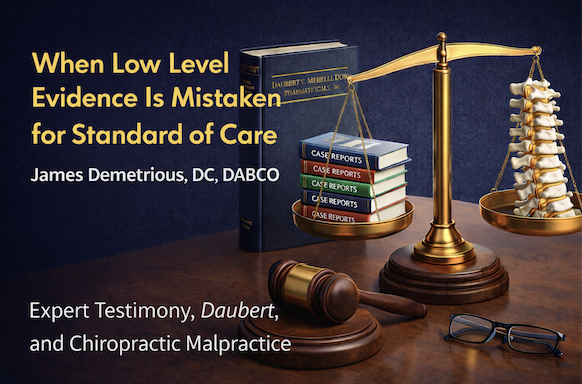
When Low Level Evidence Is Mistaken for Standard of Care – A Caution Regarding Expert Testimony, Bias, and the Integrity of Our Profession
Written by: James Demetrious, DC, DABCO
Board-Certified Chiropractic Orthopedist
Founder and CEO, PostGradDC
In recent years, I have become increasingly concerned with a trend I see in malpractice litigation involving chiropractors. Some expert witnesses are attempting to construct “standards of care” based not on prevailing clinical practice, not on accredited chiropractic education, and not on high level epidemiologic evidence, but on isolated case reports and speculative interpretations of the literature.
Case reports have value. They alert us to unusual presentations. They generate hypotheses. They remind us to remain vigilant. But they do not establish causation. They do not define incidence. And they certainly do not, by themselves, create enforceable standards of care.
Yet in some courtrooms, they are being presented as if they do.
The Hierarchy of Evidence Still Matters
As clinicians, we were all trained in the hierarchy of evidence. At the lower end are expert opinions and case reports. At the higher end are well designed observational studies, randomized trials, systematic reviews and meta-analyses. That hierarchy exists for a reason.
To ignore that body of literature and instead rely on a handful of case reports and unsubstantiated commentary to assert causation is not evidence-based reasoning. It is selective reasoning. And selective reasoning is not science.
Standards of Care
Standards of care are derived from what reasonably prudent practitioners with similar education and training would do under similar circumstances. They are reflected in:
- Accredited chiropractic college curricula
- Board certification standards
- Widely accepted clinical guidelines
- Prevailing patterns of practice
They are not derived from isolated adverse event reports, particularly when those reports cannot establish causation or incidence. When an expert attempts to impose requirements that are not taught in chiropractic colleges, not supported by consensus guidelines, and not reflected in actual practice patterns, that is not defining a standard. It is constructing one. There is a difference.
Daubert and the Reliability Requirement
The Supreme Court’s decision in Daubert v. Merrell Dow Pharmaceuticals established that expert testimony must be both relevant and reliable [4]. Courts are tasked with evaluating whether an expert’s opinions are grounded in methods that are scientifically valid and properly applied.
Key considerations include whether the theory is testable, whether it has been subjected to peer review, whether error rates are known, and whether it is generally accepted within the relevant scientific community.
Case reports, selective or confirmation bias, and commentary lacking methodological rigor cannot establish error rates or relative risk. They do not determine generalizability, nor do they quantify causation. At best, they are descriptive observations, not determinative evidence.
When such material is presented as determinative, as if it resolves questions of causation, risk magnitude, or standard of care, the distinction between scientific analysis and advocacy becomes blurred.
Financial Incentive and Repetitive Plaintiff Testimony
Another uncomfortable issue must be addressed. When experts testify in dozens of active cases against chiropractors, the profession is entitled to ask a reasonable question: does repetition shape perspective?
There is nothing inherently improper about being compensated for expert testimony. However, when a professional repeatedly appears almost exclusively on one side of litigation, and derives substantial income from doing so, structural bias becomes a legitimate concern.
Financial remuneration, combined with repeated adversarial engagement against the same profession, creates the potential for confirmation bias. Literature may be selectively interpreted. Ambiguities may be resolved in one direction. Rare events may be framed as foreseeable inevitabilities.
The Institute of Medicine has long recognized that conflicts of interest can influence professional judgment [6]. Bias is not always malicious. Often it is subtle, cumulative, and reinforced over time. But its impact can be profound.
The Broader Impact on Chiropractic and Patients
The consequences of this dynamic extend beyond individual lawsuits. When exaggerated risk narratives are repeated in courtrooms and public forums, they influence perception. Defensive practice increases. Unnecessary imaging increases. Referral thresholds shift. Fear enters the clinical equation.
Most importantly, patients may hesitate to seek care that has been shown to provide benefit in pain reduction, improved function, reduced reliance on medication, surgery and cost [7,8]. The public deserves balanced information grounded in population level data, not anecdotal amplification.
We should be vigilant regarding rare and serious conditions. We should continually refine our diagnostic algorithms. We should teach risk stratification aggressively and responsibly. But vigilance is different from distortion.
Professional Responsibility in Expert Testimony
Expert testimony carries ethical obligations. Professional organizations across healthcare have emphasized that expert witnesses must present opinions that are scientifically grounded and reflective of prevailing standards [9].
When experts selectively cite low level evidence while disregarding higher level studies, credibility suffers. When they define standards that are not recognized in education or practice, confusion results. The courtroom is not a laboratory. But it should not be divorced from scientific integrity.
In Conclusion – Protecting Science Protects Patients
Chiropractic does not benefit from shielding negligence. Legitimate deviations from accepted practice must be identified and corrected. Accountability is essential. But accountability must be anchored in sound evidence.
Case reports generate questions. They do not generate standards. Daubert exists to prevent unreliable methodology from influencing juries. When that gatekeeping function is weakened, the consequences affect not only practitioners but the patients who depend on access to appropriate, evidence informed care.
Bias whether financial, intellectual, or adversarial is not merely a professional hazard. It is a public health concern. As a profession, we must insist that standards of care be defined by comprehensive evidence, accredited education, and actual clinical practice, not by isolated anecdotes elevated beyond their scientific weight.
In doing so, we are not defending chiropractors. We are defending science. And ultimately, we are defending patients.
References
- Cassidy JD, Boyle E, Côté P, He Y, Hogg Johnson S, Silver FL, et al. Risk of vertebrobasilar stroke and chiropractic care: results of a population based case control and case crossover study. Spine. 2008;33(4 Suppl):S176–83. doi:10.1097/BRS.0b013e3181644600
- Kosloff TM, Elton D, Shulman SA, Clarke JL, Skoufalos A, Solis A. Risk of vertebral artery dissection after chiropractic spinal manipulation in Medicare beneficiaries aged 65 years and older. J Manipulative Physiol Ther. 2015;38(2):93–101. doi:10.1016/j.jmpt.2014.12.008
- Whedon JM, Mackenzie TA, Phillips RB, Lurie JD. Risk of stroke after chiropractic spinal manipulation in Medicare B beneficiaries aged 66 to 99 years. Spine. 2015;40(4):264–70. doi:10.1097/BRS.0000000000000739
- Daubert v. Merrell Dow Pharmaceuticals, Inc., 509 U.S. 579 (1993).
- Kumho Tire Co. v. Carmichael, 526 U.S. 137 (1999).
- Institute of Medicine (US) Committee on Conflict of Interest in Medical Research, Education, and Practice. Conflict of interest in medical research, education, and practice. Washington (DC): National Academies Press; 2009.. 2024 Mar 6;32:8. doi: 10.1186/s12998-024-00533-4
- Farabaugh R, Hawk C, Taylor D, Daniels C, Noll C, Schneider M, McGowan J, Whalen W, Wilcox R, Sarnat R, Suiter L, Whedon J. Cost of chiropractic versus medical management of adults with spine-related musculoskeletal pain: a systematic review. Chiropr Man Therap. 2024;32(8). doi: 10.1186/s12998-024-00533
- Weeks WB, Goertz CM, Meeker WC, Marchiori DM. Public perceptions of doctors of chiropractic: results of a national survey and examination of variation according to respondents’ likelihood to use chiropractic. J Manipulative Physiol Ther. 2015;38(8):533–44. doi:10.1016/j.jmpt.2015.08.00
- American Academy of Orthopaedic Surgeons. Standards of professionalism: orthopaedic expert witness testimony. Rosemont (IL): American Academy of Orthopaedic Surgeons; 2010.
Legal Disclaimer
This publication is intended for educational and scholarly discussion regarding evidentiary standards, professional ethics, and the appropriate interpretation of scientific literature in clinical and legal contexts. It does not constitute legal advice, medical advice, or expert witness consultation. The content herein is not directed toward any specific pending litigation, individual, or jurisdiction.
Standards of care are determined through fact specific legal analysis within applicable statutory and case law frameworks and may vary by jurisdiction. Readers are advised to consult qualified legal counsel for guidance regarding specific legal matters. Clinical decisions must be based on independent professional judgment, current scientific evidence, patient specific presentation, and applicable regulatory requirements.
The opinions expressed are solely those of the author and are presented for academic and professional discourse.
Author Disclosures
James Demetrious, DC, DABCO is a board certified chiropractic orthopedist and the founder of PostGradDC, a for profit postgraduate continuing education organization that provides educational programming to licensed chiropractors. He receives compensation for course development, teaching, and professional speaking engagements through PostGradDC.
Dr. Demetrious has participated in medicolegal consultation and expert review involving chiropractic standards of care. He does not receive compensation contingent upon the outcome of any specific legal matter discussed or implied within this publication.
No external funding was received for the preparation of this manuscript.
Conflict of Interest Declaration
Dr. Demetrious declares that he is an independent member of the NCMIC Speakers Bureau. His participation in the NCMIC Speakers Bureau is educational in nature. He is not an employee, officer, policy maker, or spokesperson for NCMIC. The views expressed in this article are solely those of the author and do not represent the official positions of NCMIC or any affiliated organization.
The author affirms that the opinions presented are grounded in professional training, board certification, clinical experience, peer reviewed literature, and applicable legal precedent. He declares no financial interest contingent upon the outcome of any litigation referenced or discussed in general terms within this publication.

PostGradDC offers advanced post-graduate chiropractic continuing education. Our founder, Dr. James Demetrious, is a distinguished board-certified chiropractic orthopedist, educator, author, and editor.
© 2026 – James Demetrious, DC, DABCO. Open Access. Unrestricted use, distribution, and reproduction are allowed in any medium, provided you give appropriate credit by citing the original author and source: Demetrious J. When Low Level Evidence Is Mistaken for Standard of Care – A Caution Regarding Expert Testimony, Bias, and the Integrity of Our Profession. PostGradDC.com; 2026.
