
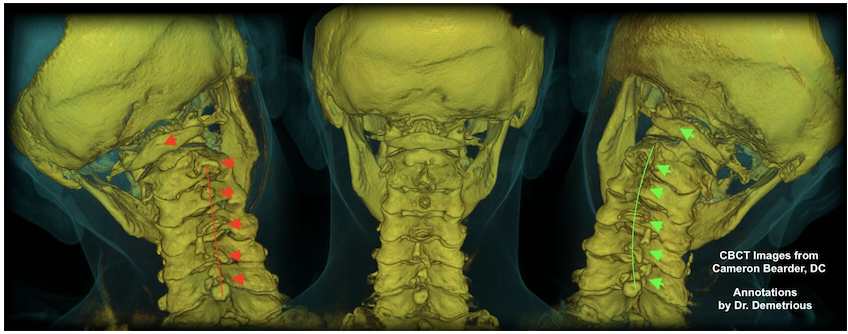
Degenerative Coupled Hypomobility: Restoring Intersegmental Motion
By James Demetrious, DC, DABCO
Board-Certified Chiropractic Orthopedist – Founder, PostGradDC
Coupled Motion Is Three-Dimensional
Spinal movement does not occur in isolated X-Y-Z planes. Flexion, extension, lateral flexion, axial rotation, and translation occur in coordinated combinations known as coupled motion. The direction and magnitude of coupling vary by spinal region, vertebral level, posture, anatomy, and loading conditions. Recent meta-analysis confirms a particularly strong relationship between lateral bending and axial rotation, while demonstrating that coupling patterns cannot be reduced to one universal rule (Liebsch & Wilke, 2025).
Degeneration can disrupt this coordination, producing restricted, asymmetric, and increasingly compensatory movement.
The Degenerative Cascade
Degenerative coupled hypomobility frequently begins within the intervertebral disc. Loss of proteoglycans and water reduces the hydrostatic behavior of the nucleus pulposus. The disc becomes less capable of distributing compression and accommodating combined rotation and translation.
Annular fibrosis adds stiffness, while fissuring and lamellar delamination create regions with different mechanical properties. Rather than deforming uniformly, the disc may resist movement in one direction while loading unevenly in another. Dynamic MRI demonstrates that cervical discs normally undergo complex, nonuniform internal deformation during movement, highlighting how changes in disc composition may alter functional mechanics before conventional imaging fully explains the restriction (Chan et al., 2021).
As disc height decreases, facet relationships, ligamentous tension, and muscular moment arms change. The instantaneous axes of rotation may migrate, altering how the motion segment receives and distributes force. Advanced degeneration generally restricts mobility, while adjacent unaffected segments may compensate for the lost movement (Lindenmann et al., 2022).
Uncovertebral Joint Degeneration
The uncovertebral joints are important mechanical guides within the subaxial cervical spine. They help direct flexion and extension, limit excessive lateral translation, and contribute to the coupling of lateral flexion and axial rotation.
Disc-height loss changes uncovertebral joint contact and load distribution. Progressive cartilage deterioration, joint-space narrowing, uncinate-process hypertrophy, sclerosis, and osteophyte formation can increase resistance to lateral flexion and alter its normally associated rotation. Asymmetric uncovertebral degeneration may restrict coupled motion more strongly in one direction than the other. It can also narrow the intervertebral foramen and produce radicular symptoms that further limit movement through pain and protective guarding.
CT research indicates that uncovertebral degeneration may begin during early adulthood, becomes progressively more pronounced with age, and most commonly affects C5–C6, followed by C4–C5 and C6–C7 (Huang et al., 2021). These findings emphasize that cervical coupled hypomobility may reflect degeneration of the entire motion segment, rather than disc or facet disease alone.
Facet Remodeling and Mechanical Restriction
Progressive facet degeneration adds another layer of hypomobility. Articular cartilage loss, joint-space narrowing, subchondral sclerosis, capsular fibrosis, and osteophytes reduce joint compliance. Facet orientation and tropism also influence rotational stiffness, disc stress, and coupled movement (Ke et al., 2021).
Degenerative scoliosis and vertebral wedging further complicate motion. Asymmetric disc collapse creates unequal facet and uncovertebral loading. Coupled lateral flexion and rotation become restricted, while adjacent segments assume greater mechanical demands. Global range may appear acceptable even though intersegmental motion is poorly distributed.
Hypomobility Effects
Pain and mechanical uncertainty may provoke muscular co-contraction, creating functional hypomobility overlying instability. The clinician must consider the segmental influence of segmental hypomobility, and its effect on sensorimotor input, spinal and supraspinal control, CSF, lymphatic and venous drainage, and movement dependent influx/efflux at the IVDs and synovial joints.
Chiropractic Adjustments and Intersegmental Mobility
When degenerative restriction remains mechanically modifiable, chiropractic manipulation may provide an important benefit. A carefully directed high-velocity, low-amplitude impulse introduces movement into a hypomobile region, loads periarticular tissues, and may produce brief facet separation within the available physiological range. Force, velocity, amplitude, direction, and contact location influence the mechanical response (Gyer et al., 2022).
Chiropractic adjustments may improve coupled movement distribution by reducing mechanical resistance and pain-related guarding. Mechanoreceptor stimulation and altered afferent input may reduce segmental nociceptive processing and reflex muscular resistance, allowing movement to occur more comfortably and fluidly (Gevers-Montoro et al., 2021).
Movement inherent to highly skilled chiropractic adjustments that address X-Y-Z segmental movement patterns may improve biomechanic , neurologic, and nutrient/metabolic waste exchange.
The objective is not to reverse arthrosis or permanently reposition a vertebra. Rather, manipulation may restore movement within the segment’s remaining anatomical capacity, improve intersegmental load sharing, and reduce excessive compensatory demand.
Clinical Pearl
Degenerative coupled hypomobility represents altered disc deformation, uncovertebral and facet guidance, capsular elasticity, muscular restraint, and load sharing. Properly selected chiropractic spinal adjustments may improve intersegmental mobility and restore greater fluidity within the cervical spine’s remaining physiological capacity.
References
- Liebsch C, Wilke H-J. Coupled motions of the spine under standardized in vitro conditions: a systematic review and meta-analysis. Front Bioeng Biotechnol. 2025;13:1686524. doi:10.3389/fbioe.2025.1686524
- Lindenmann S, Tsagkaris C, Farshad M, Widmer J. Kinematics of the cervical spine under healthy and degenerative conditions: a systematic review. Ann Biomed Eng. 2022;50(12):1705-1733. doi:10.1007/s10439-022-03088-8
- Chan DD, et al. In vivo intervertebral disc deformation: intratissue strain patterns within adjacent discs during flexion-extension. Sci Rep. 2021;11:729. doi:10.1038/s41598-020-77577-y
- Huang T, Qin J, Zhong W, Tang K, Quan Z. The CT assessment of uncovertebral joints degeneration in a healthy population. Eur J Med Res. 2021;26:145. doi:10.1186/s40001-021-00619-2
- Ke S, et al. The biomechanical influence of facet-joint parameters on the corresponding segment in the lumbar spine: a finite-element analysis. J Orthop Surg Res. 2021. PubMed search
- Gyer G, Michael J, Inklebarger J, Tedla JS. Effects of biomechanical parameters of spinal manipulation: a critical literature review. J Integr Med. 2022;20(1):4-12. doi:10.1016/j.joim.2021.10.002
- Gevers-Montoro C, Provencher B, Descarreaux M, Ortega de Mues A, Piché M. Neurophysiological mechanisms of chiropractic spinal manipulation for spine pain. Eur J Pain. 2021;25(7):1429-1448. PubMed
With gratitude: Many thanks to Cameron Bearder, DC, for sharing his CBCT image.

PostGradDC offers advanced post-graduate chiropractic continuing education. Our founder, Dr. James Demetrious, is a distinguished board-certified chiropractic orthopedist, educator, author, and editor.
© 2026 – James Demetrious, DC, DABCO. Open Access. Unrestricted use, distribution, and reproduction are allowed in any medium, provided you give appropriate credit by citing the original author and source: Demetrious J. Degenerative Coupled Hypomobility: Restoring Intersegmental Motion. PostGradDC.com; 2026.
