
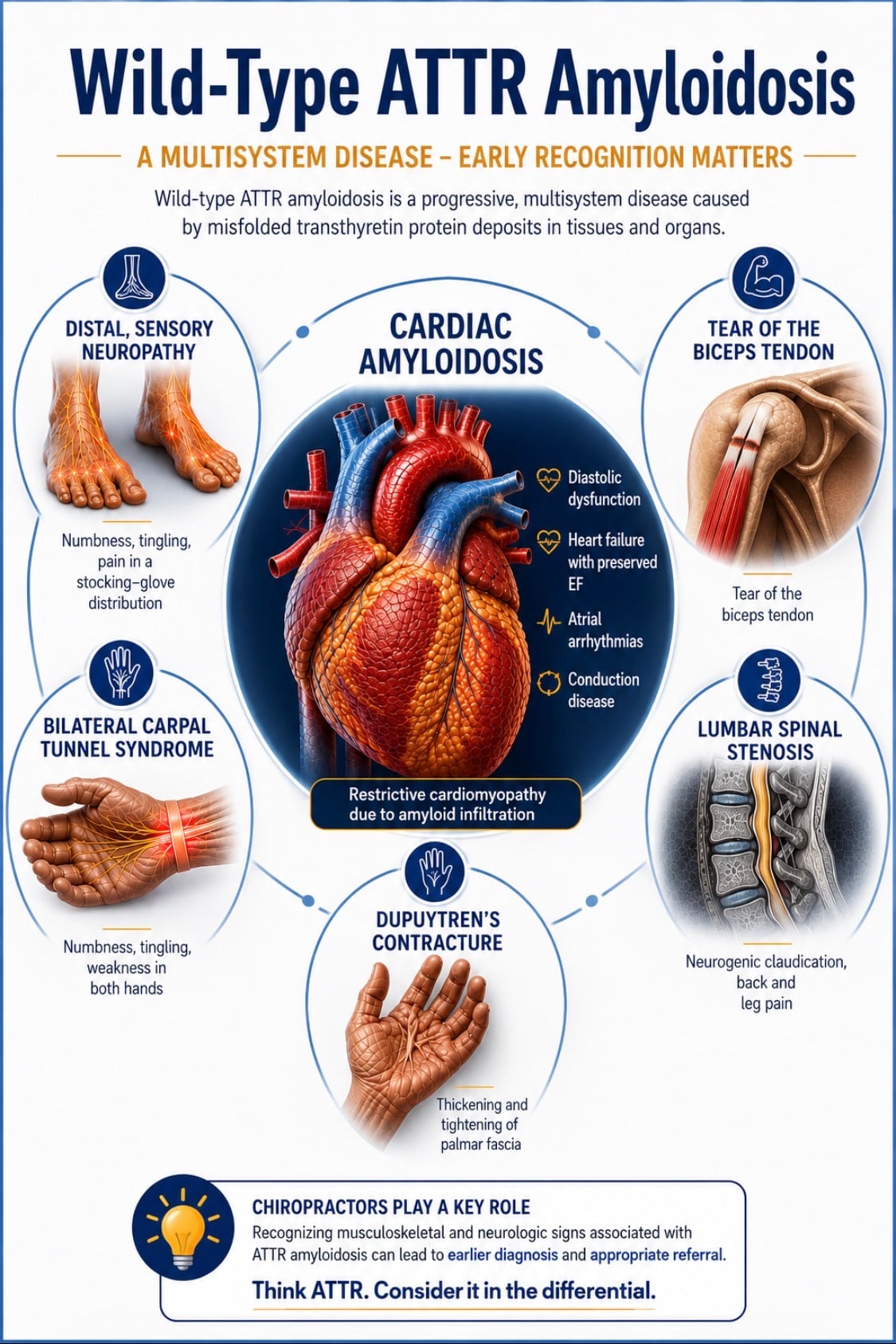
Wild-Type ATTR Amyloidosis: A Window for Earlier Diagnosis
Written by: James Demetrious, DC, DABCO
Board-Certified Chiropractic Orthopedist
Founder and CEO, PostGradDC
Introduction
Wild-type transthyretin amyloidosis (ATTRwt) has long been framed as a cardiac disease of older adults. It is important to recognize that ATTRwt is systemic disease process. Transthyretin-derived amyloid deposits not only in the myocardium but also in tenosynovial, ligamentous, and peripheral nerve tissue, producing a constellation of neuromuscular and musculoskeletal manifestations that frequently precede overt cardiomyopathy by years.[1,2] Recognizing these features offers clinicians a valuable diagnostic window in which disease-modifying therapy can be started before irreversible organ damage occurs.[1,3]
Prevalence
ATTRwt is the most common form of ATTR amyloidosis, accounting for roughly 75% of cases, and TTR cardiomyopathy overall affects an estimated 50,000 to 150,000 people in the United States.[2] It is strongly age-related: autopsy studies detect wild-type amyloid deposits in the myocardium of 20–25% of individuals older than 80 years and up to 37% of those older than 95.[2,4] The mean age at diagnosis is approximately 74 years.
Historically more than 90% of clinically diagnosed patients have been men, although active screening and post-mortem series suggest the disease is underrecognized in women.[5] It is also an important and underdiagnosed cause of heart failure with preserved ejection fraction and aortic stenosis in the elderly.[2]
Clinical Presentations
Carpal tunnel syndrome (CTS) is the single most common musculoskeletal manifestation and is often the earliest sign, preceding cardiac diagnosis by roughly 5 to 10 years.[1,6] It is reported in 70–84% of ATTRwt patients, is usually bilateral, and in one large cohort CTS release surgery had been performed a median of ten years before the amyloidosis diagnosis.[7,8]
With ATTRwt CTS amyloid infiltrates the tenosynovium and compresses the median nerve, so the nerve itself is typically not enlarged on high-resolution ultrasound.[9] Bilateral CTS in a man without occupational risk factors, or recurrence after surgical release, should prompt suspicion of amyloidosis.[3]
A distal, symmetric and predominantly sensory polyneuropathy is increasingly recognized, reported in 60–84% of patients depending on the neurophysiologic protocol used.[7,8,10,11] Compared with hereditary ATTRv, this neuropathy is generally milder and largely sensory with impaired vibration sense.
A rarer amyloid myopathy may cause weakness misattributed to deconditioning.[6] Motor involvement typically produces loss of lower-limb reflexes.[7,8][10]
Tendinous involvement adds further clues including spontaneous biceps tendon rupture (“Popeye sign”), trigger finger, and Dupuytren’s contracture.[3,6,7,8,12]
Spinal stenosis, driven by amyloid infiltration of the ligamentum flavum, affects roughly 11% to one-third of patients. Importantly, bilateral CTS and spinal stenosis mark an earlier, more treatable disease stage and better survival.[13]
The Role of Chiropractic
These conditions carry particular relevance for the chiropractic office, where older patients commonly present with low back pain, radiculopathy from spinal stenosis, neck pain, and hand or wrist paresthesias. A chiropractor may be the first clinician to encounter the red-flag pattern of bilateral CTS, spinal stenosis, Dupuytren’s contracture, spontaneous biceps tendon rupture, and distal sensory loss.
Recognizing this cluster, rather than treating each complaint in isolation should prompt a careful differential diagnostic assessment and timely medical referral for cardiac and hematologic evaluation. If recognized, medical assessment, echocardiography, technetium-based scintigraphy, and monoclonal protein screening can be performed.[1][3] Attention to these neuromusculoskeletal signals transforms ATTRwt from a late cardiac diagnosis into an earlier, more actionable condition.
Conclusion
Wild-type ATTR amyloidosis is a progressive, potentially fatal systemic disease. Its musculoskeletal manifestations may precede recognized cardiac involvement by years. Chiropractors routinely encounter associated conditions, including bilateral carpal tunnel syndrome, lumbar spinal stenosis, biceps tendon rupture, Dupuytren’s contracture, and peripheral neuropathy. Recognition of this clinical pattern should prompt consideration of ATTRwt and timely medical referral. Earlier detection may facilitate diagnosis and disease-modifying treatment, highlighting the chiropractor’s important role in improving patient outcomes.
References
- Musculoskeletal Manifestations Associated With Transthyretin-Mediated (ATTR) Amyloidosis: A Systematic Review. Aldinc E, Campbell C, Gustafsson F, et al. BMC Musculoskeletal Disorders. 2023;24(1):751. doi:10.1186/s12891-023-06853-5.
- Cardiac Amyloidosis Due to Transthyretin Protein. Ruberg FL, Maurer MS. JAMA. 2024;331(9):778-791. doi:10.1001/jama.2024.0442.
- Carpal Tunnel Syndrome: Updated Evidence and New Questions. Padua L, Cuccagna C, Giovannini S, et al. The Lancet. Neurology. 2023;22(3):255-267. doi:10.1016/S1474-4422(22)00432-X.
- Transthyretin Amyloid Cardiomyopathy: JACC State-of-the-Art Review. Ruberg FL, Grogan M, Hanna M, Kelly JW, Maurer MS. Journal of the American College of Cardiology. 2019;73(22):2872-2891. doi:10.1016/j.jacc.2019.04.003.
- Natural History of Wild-Type Transthyretin Cardiac Amyloidosis And Risk Stratification Using a Novel Staging System. Grogan M, Scott CG, Kyle RA, et al. Journal of the American College of Cardiology. 2016;68(10):1014-20. doi:10.1016/j.jacc.2016.06.033.
- Transthyretin amyloidosis: Putting myopathy on the map. Pinto MV, Milone M, Mauermann ML, et al. Muscle & Nerve. 2020;61(1):95-100. doi:10.1002/mus.26723.
- Neurological Examinations of Patients Initially Diagnosed With Wild-Type Transthyretin Amyloidosis (wtATTR). Stögbauer J, Kämpfer N, Kindermann I, et al. European Journal of Neurology. 2025;32(9):e70353. doi:10.1111/ene.70353.
- Same Same, but Different? The Neurological Presentation of Wildtype Transthyretin (ATTRwt) Amyloidosis. Kleefeld F, Scherret E, Knebel F, et al. Amyloid : The International Journal of Experimental and Clinical Investigation : The Official Journal of the International Society of Amyloidosis. 2022;29(2):92-101. doi:10.1080/13506129.2021.2014448.
- Ultra High‐Resolution Ultrasound Features of Carpal Tunnel Syndrome in Transthyretin Amyloidosis: A Cross‐Sectional Study. Gandhi Mehta RK, Miller N, Cartwright MS, Traub R, Evans J. Muscle & Nerve. 2026;73(5):867-874. doi:10.1002/mus.70181.
- Polyneuropathy in Wild-Type Transthyretin Amyloidosis. Sciarrone MA, Vitali F, Guglielmino V, et al. European Journal of Neurology. 2025;32(11):e70374. doi:10.1111/ene.70374.
- Polyneuropathy in Hereditary and Wildtype Transthyretin Amyloidosis, Comparison of Key Clinical Features and Red Flags. Siemer JM, Grote-Levi L, Hänselmann A, et al. Scientific Reports. 2025;15(1):35028. doi:10.1038/s41598-025-21745-5.
- Characteristics and Prognosis of Wild-Type Transthyretin Amyloid Cardiomyopathy Patients Diagnosed Before 65 Years Old. Guijarro D, Eicher JC, Bézard M, et al. JACC. Advances. 2025;4(12 Pt 2):102354. doi:10.1016/j.jacadv.2025.102354.
- Diagnostic, Therapeutic, and Prognostic Implications of Carpal Tunnel Syndrome and Spinal Stenosis in Wild-Type ATTR-Cardiomyopathy. Debonnaire P, Dujardin K, Donal E, et al. JACC. Advances. 2026;5(3):102631. doi:10.1016/j.jacadv.2026.102631.

PostGradDC offers advanced post-graduate chiropractic continuing education. Our founder, Dr. James Demetrious, is a distinguished board-certified chiropractic orthopedist, educator, author, and editor.
© 2026 – James Demetrious, DC, DABCO. Open Access. Unrestricted use, distribution, and reproduction are allowed in any medium, provided citation of the author and source: Demetrious J. Wild-Type ATTR Amyloidosis: A Window for Earlier Diagnosis. PostGradDC.com; 2026.
